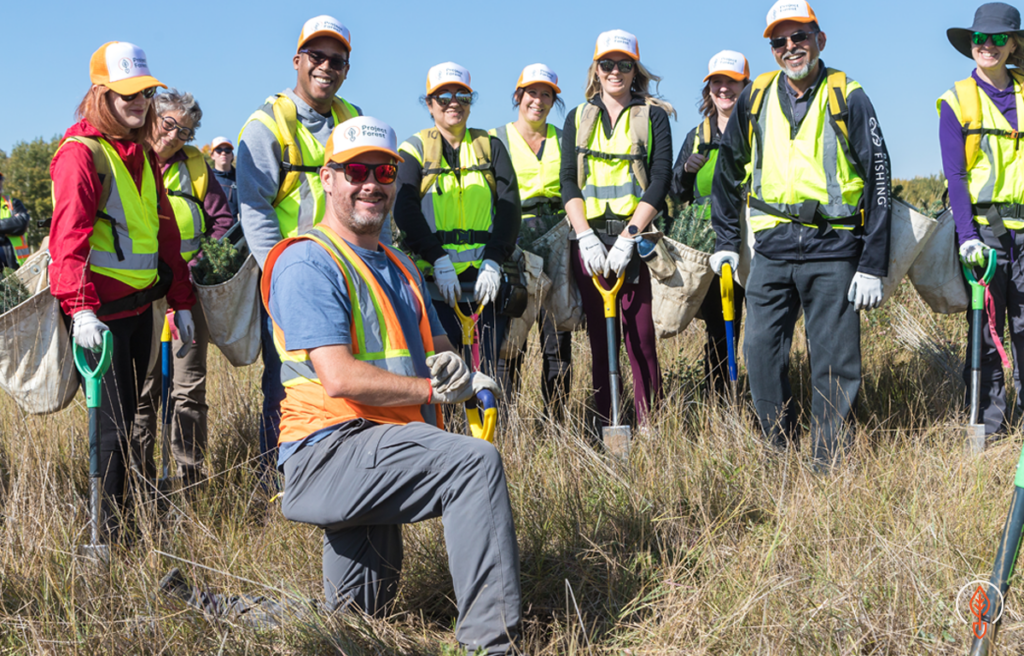
On May 22, 2026 Project Forest will celebrate the planting of our millionth tree.
While we could wax on about what this means for us and our community, we thought you’d much rather hear it from the founder himself, Mike Toffan!
Mike spent his youth imagining what a life spent in the forest could look like and made it come to life when he became a forester. While planting trees definitely scratched a significant itch, Mike became drawn to a new challenge.
“When I created Project Forest, I was inspired to solve a couple challenges. First, find a way to make it easy and attractive for companies that don’t need to plant trees to plant trees,” explains Mike. “And the vision was to find land that was sitting idle and transition it back into a forest.”
Mike’s vision caught the fast-track to success with a Nature Conservancy of Canada partnership where Project Forest was able to offer a way for the organization to accomplish some of their rewilding goals without any cost to them.
With this, Project Forest’s first tree was planted at Golden Ranches, unused agricultural land turned forest.
“We held our corporate planting events at Golden Ranches for a long time. And the very last group that came through was the Alberta Motor Association,” Mike reminisces. “And at the end of that day, as we are about to go on our nature walk. I saw a mature and juvenile bald eagle. Two of them fly over us towards the lake. I’ve never seen the bald eagle around South Cooking Lake before… I think that’s going to be a moment I remember for a long, long time. The site where it all started, the first tree of a million.”
Now, Project Forest’s millionth tree will be planted as part of the Siksika Nation Community Shelterbelt Program, Project Forest’s largest project. Leading up to next year’s 150th anniversary of the signing of Treaty 7, Project Forest will be working with Blackfoot Crossing to host a Millionth Tree Celebration and planting a ceremonial millionth tree on that land that will last for generations to come.
“It’s really important, meaningful and symbolic to be able to have that event at Blackfoot Crossing,” explains Mike. “The Siksika Nation Community Shelterbelt Program exists because there is a major nature deficit throughout their nation and most nations across the prairie provinces of Canada.”
For about 100 years, the government of Canada had something called the Prairie Shelterbelt Program. Western farmers and landowners were receiving free trees and about a billion trees were given out over 100 years. The nations were not included in this program. Project Forest built relationships with Siksika Nation and finally appropriated land to build the shelterbelt.
“It is a unique example of how somebody like myself, who’s a Forester, can give back and really improve people’s lives in a meaningful way simply by planting trees,” says Mike. “When we think about reconciliation and what that means, it’s a simple yet very complicated conversation. We’re all moving forward together to try and make things better, but what it means to the individual is very unique. As a Forester, being able to use my skillset to inspire people to fund this work and bring projects to life is a really unique opportunity to bring back land that should have never been cleared in the first place. We’re able to gift the Nation nature in a way that was not available to the nations for so many years.”
Thinking back on the first tree planted, now anticipating Project Forest’s millionth tree, Mike sees what he’s built as bigger than the trees they’ve planted.
“What we’re doing here is we’re creating a community of environmentally like-minded, responsible businesses that come together to solve big challenges,” he says. “We were fortunate enough to have early adopters supporting us before we even launched. That really set the stage for other companies to trust us and invest in the vision. And now that we have a track record behind us, we’ve secured more than $10 million in funding since we started the organization.”
To Mike, Project Forest isn’t the hero rewilding Canada — they’re just the facilitator.
“The groups that really make this happen and need to be celebrated are the rights holders and land partners that have trusted us with their land, and the funding partners because without that community coming together and trusting, this wouldn’t happen,” Mike shares.
From one to one million, Project Forest’s journey is just beginning, with our next million trees within sight for 2027. Join Project Forest to plant hope, community and reconciliation for generations to come.